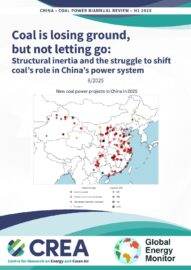
While China’s unprecedented clean energy growth in 2025 has led to a drop in coal power output and carbon dioxide (CO2) emissions, coal power projects continue on the uptick despite the building momentum of the clean energy transition and climate deadlines.
Today, the Centre for Research on Energy and Clean Air and Global Energy Monitor have published their H1 2025 coal power review that reveals a boom in commissioned coal projects, while new and revived proposals are the highest in a decade, both upward trends after some signs of cooling in 2024.
In H1 2025, 21 gigawatts (GW) of coal power were commissioned, the highest amount in the first half of the year since 2016, with projections for the full year exceeding 80 GW. This increase in commissions follows on the tail of the 2022-2023 coal power permitting surge that saw two new coal projects permitted per week, on average, totalling more than 100 GW of coal power approved per year. This trend will likely continue into 2026 and 2027, unless policy action is taken.
Although only 25 GW were permitted in H1 2025, new and revived projects came to 75 GW in H1 2025, the highest in a decade, and construction starts and restarts reached 46 GW, equivalent to the entire coal power capacity of South Korea.
This rush of activity signals possible pressure from the industry to expand coal projects as a last ditch effort before China’s 2030 carbon peaking deadline, right when strategic phase-down should be the priority to meet climate goals and as clean energy is meeting all of new power demand growth.
In June 2025, coal’s share in power generation dropped to a nine-year low of 51%, and only made up 34% of China’s total installed capacity, while renewables accounted for 60%, pointing to the ongoing trend of coal losing steam while an artificial push attempts to expand rather than phase down its historic role.
Although China pledged in 2022 that coal should play a flexible, supporting role while renewables are integrated, this policy has yet to be implemented in any meaningful way. Further reform and incentives are needed to transition into scaling down coal power generation and planning a coal exit strategy: in H1 2025, only 1 GW of coal power was retired. 13 GW need to be retired by the end of 2025 to meet the 14th Five-Year Plan goal of retiring 30 GW by the end of 2025.
With the Nationally Determined Contributions (NDCs) and 15th Five-Year Plan on the horizon, China has a critical opportunity to set binding targets and initiate policy reform that could confirm China’s role as a global leader in the energy transition.
Qi Qin, lead author of the report and China Analyst at CREA: "China’s clean energy boom is driving both economic growth and decarbonisation, but continued coal expansion risks holding it back. More coal power plants would not only waste investment, but also crowd out renewables–the real engine of China’s economic future. To ensure energy security and sustained economic growth, the priority now must be to build a more flexible power system, stop adding new coal power, and set a clear path for coal’s decline."

Coal power development in China in the first half of 2025 shows no sign of easing, leaving emissions on a high plateau and stranding coal in the system for years to come. To ensure meeting its carbon peaking deadline by the end of the 15th Five-Year Plan period, China must immediately commit to a set of strong policies to phase down coal power development and shut down high-emission and low-efficiency coal units.
Christine Shearer, Research Analyst at Global Energy Monitor