
1. Introduction
The full ownership data set includes all levels of ownership, entity identifiers (such as PermIDs, LEIs, and UK Companies House IDs), HQ and Registration Countries, and local and other names. It also discloses data sources for almost all ownership connections in the dataset.
In addition to the Ownership tracker, we release our data in the other GEM trackers that we collaborate with. Our team has enhanced, updated, and expanded the ownership data in our collaborating trackers. In revamping this data, we have organized the data following Open Ownership’s Beneficial Ownership Data Standard, or BODS. We adopted BODS because it is considered the only widely used standard for organizing data on ownership structures. The data has been enhanced by adding missing ownership data, bringing other ownership data up to date, making the ownership data consistent across our collaborative trackers and adding additional details on entities, as described below.
2. Methods
The terminology used here conforms with BODS whenever relevant. Accordingly, by “entities,” we are referring to companies, governments, government agencies, and other bodies that are involved in ownership.
Our ownership data is stored in a custom PostgreSQL database, which allows for representation of hierarchical relationships between various entities involved in ownership of projects, such as power plants, pipelines, or coal mines. Other sources may refer to our term “projects” as “assets”; we consider the two terms to be equivalent.
Each piece of the ownership data pertains to one of two types of relationships:
- Immediate owners of projects: We record each entity that directly owns a project (such as a power plant) and the percentage that entity holds in the project’s ownership structure when available.
- Higher-level ownership: We additionally record the entities that own the immediate owners of projects, including the higher-level entities’ percent share when available. We trace ownership structures up to the highest level owner(s) identifiable in open sources. These highest level owners include:
- Publicly traded companies,
- The highest privately held entity in any given ownership branch,
- State bodies or governments, and
- Actual persons (not a company), who we refer to as “natural person(s)”
Each project’s ownership tree thereby includes immediate, intermediate, and ultimate ownership, as applicable.
As in BODS, our dataset refers to a lower-level entity as the “subject” and the higher-level entity as the “interested party.”
In addition, the database stores various attributes of the entities, as described below. This additional data helps to provide unambiguous identification of the entities and can also enable certain types of analyses.
2.1 Types of Entities
In the database, each entity is assigned a type, as either a legal entity, state, state body, anonymous entity, natural person, unknown entity, or arrangement, following the definitions in BODS.
2.1.1 Legal Entity
As defined by BODS, a legal entity is an organization created with a memorandum of incorporation or similar registration documents, and which is registered by a government. There are many types of legal entities, including Corporation, Limited Liability Company, and Company Limited. For our ownership work, we define “legal entity” in line with BODS terminology.
In addition, in our database, we differentiate privately owned and publicly traded companies (also known as a publicly held company, publicly listed company, or listed company). This is in line with BODS schema for marking publicly listed companies. Another reason we differentiate is because in some jurisdictions, such as the United States, public companies are required to publish audited financial statements and information on beneficial ownership over 5%. Identifying public companies is also useful for guiding research, since publicly traded companies tend to disclose ownership information in their annual reports or in filings made with the stock exchange on which they are traded.
2.1.2 State
The entity type “state” refers to national, subnational, and local governments. In BODS terminology, it is a country, nation, or community with legal sovereignty within a territory. In the dataset, we follow a convention for naming states:
- National governments: “Government of X.”
- State/regional governments: “State of X” or “Province of X” (for example), depending on the name of the type of country subdivision.
- City governments: “City of X” or “Municipality of X.”
- US Cities: follow the same pattern as well as adding the state where the city is located in parentheses.
- For example, “City of Chicago (Illinois)” for the city government in Chicago, Illinois, United States.
- US Cities: follow the same pattern as well as adding the state where the city is located in parentheses.
2.1.3 State Body
In BODS terminology, “state body” refers to a core administrative or legislative body within a state’s apparatus. For example, these could be ministries or government agencies. State bodies are entered as distinct from the state (the government) to make the ownership data as specific as possible.
When labeling state bodies in our dataset, we use the official name of the government agency or ministry as the entity name. In cases where ministry or government agency names are similar to government agency names in other countries, we enter the country name in parentheses at the end of the entity name—for example, “Ministry of Energy (Iraq).”
2.1.4 Arrangement
For other cases of ownership that do not fit into any of the categories above, we have applied a general category “arrangement,” based on advice from Open Ownership’s staff.
We apply the category of “arrangement” to entities that meet the following criteria:
- Joint ventures that are not registered in a government business registry
- Other entities, such as trusts, universities, and certain general partnerships, that are not registered in a business registry and are found to hold ownership in a project or subject
- Business groups that are described in online sources as holding ownership of a project or subject but for which a principal registered legal entity (i.e., a parent or holding company) could not be identified in online sources and no other information regarding the ownership of the asset or subject is available
2.2 Sources and Datasets employed
The availability of data on ownership varies widely between countries, and we rely on the most authoritative open data that is available at the time of this work. This includes diverse sources, such as state business registries, government data sets, company reports, news articles, stock exchanges, and other sources. On GEM.wiki, we publish data for each project (e.g., power plant) which shows the ownership data as well as the data sources whenever available.
Examples of the government data sets we use to compile ownership data include Form EIA-860, which is a United States government agency electricity dataset from the U.S. Energy Information Administration. Additionally, we gather ownership data from various company reports, such as annual reports and financial statements, which may identify the subsidiaries of a company and/or the projects owned by a company. In some cases, we obtained ownership information from news articles from accredited sources (such as Reuters, Bloomberg, and S&P Global), and press releases from company websites.
2.3 Entity Data Structure
For each entity, we store data in the following data fields, as available and as relevant:
- Entity Type: The options follow the definitions in BODS, as described above, with the most common types being:
- Legal entity
- State
- State Body
- Arrangement
- Legal Entity Type: This field is used only when the “Entity Type” is a “Legal entity.” The entries are standardized in their abbreviated forms; for example, a Limited Liability Company is standardized as “LLC.”
- Entity Status: This field is used if the entity is dissolved or amalgamated.
- Publicly Listed: This indicates whether a company is “listed,” that is, it has stock listed on a public stock exchange. (Such companies are also referred to as publicly traded or publicly held.) This option is available only for the entity type “legal entity.”
- Abbreviation: The abbreviation of the entity name (if any), based on its primary name. This can be an acronym or other shortening of the name.
- Name local: The name of the company in the local language (e.g., for a Chinese company, the name in Chinese).
- Name other: Multiple names can be added, in English and/or other languages. When an entity was previously referred to by another name, we enter former names with “[former]” appended at the end. For example, “Anergi International Ltd” has the entry “Applied Energy Services [former].”
- Registration Jurisdiction—Country & Subdivision. For legal entities registered with a federal business registry, the country is listed. For legal entities registered with a provincial or state registry only, the subnational division is additionally listed.
- Headquarters Jurisdiction—Country & Subdivision. The location of the headquarters can be listed by country and by subdivision, as available.
- Organization Identifiers: This indicates an ID for an entity and is most commonly available only for legal entities. The ID systems currently in use in our data set are listed below, with the short identifiers in parentheses as assigned by org-id.guide.
- Global Legal Entity Identifier Index (XI-LEI)
- Refinitiv PermID (XI-PID)
- UK Companies House (GB-COH)
- China’s Unified Social Credit Identifier (CN-USCI)
- China’s State Administration for Industry and Commerce (CN-SAIC)
- IDs assigned by the US Energy Information Administration, as published in Form EIA-860, for entities that own power-generating projects
- S&P Capital IQ – SPCIQ: Can be found on companies pages in your S&P IQ account
- India’s Corporate Identification Number (Ministry of Corporate Affairs) (IN- CIN)
- Russia’s Uniform State Register of Legal Entities of Russian Federation (RU-INN)
- Brazil’s National Registry of Legal Entities (Federal Revenue Service) (BR-CNPJ)
3. Research Practices
3.1 Assigning owners
When adding new entities to our database, we identify the immediate owner reported for each project in our collaborative trackers, and compare it against our database of entities to avoid duplicating entities under different names.
To ensure that we does not create duplicate entities for entities, we rely on the collection of various information including: company name in English, company name in local language, company abbreviation, entity type, legal entity type, publicly listed status, previous company names, location of registration and/or headquarters, and several organization identifiers such as the Legal Entity Identifier (LEI) issued by the Global Legal Entity Identifier Foundation (GLEIF), the Refinitiv Permanent Identifier (PermID), and national registration numbers. These identifiers and other information about the entities help us identify when one entity is being referred to in different ways.
The owners reported in authoritative data sources may not always be the immediate owner of a project. Many projects’ immediate owner is a special purpose vehicle (SPV), a type of company that is often set up to own one particular project (such as a power plant).
However, our focus is on tracing ownership “upward” to the level of ultimate parent entities (as defined below), in order to show how ownership aggregates. We do not trace ownership “downward” to identify any lower-level owner that may be below the owner reported for a particular project.
3.2 Ownership trees
Starting from the immediate owners of projects (as reported by our sources), our researchers add additional data as available on the higher-level interested parties of the starting subject entities. This terminology follows BODS, in which each relationship between two entities has a lower-level “subject” and a higher-level “interested party.”
In our database, the levels of ownership for an entity are displayed in an ownership tree. The ownership tree of an entity provides a visual representation of the different levels of ownership for a given entity.
An example is shown in Figure 2 in the following section for the ownership of JERA Co Inc., a Japanese power generation company.
3.3 Parents
To aggregate data at a high-level, we have created a particular definition for the ultimate parent entities, referred to below as simply the “parent(s).” Within each ownership tree (or tree branch), we define a parent following the rules described below:
- The lowest-level publicly listed company, if any.
- If there are no publicly listed companies, then the highest-level state-owned enterprise, if any. That is, the parent is not assigned to a state or state body if there is a lower-level legal entity.
- If there are no listed companies or state-owned enterprises, then the ultimate parent is assigned to the highest-level privately owned company. Natural persons are not assigned as parents, as long as there is available data on lower-level entities. In certain cases, in which the highest-level owners are general investors, such as major banks, then we define the parent as the highest-level energy company in that tree or tree branch.
- One exception is for the case of China, in which certain entities are designated as central enterprises by the central government. The State-owned Assets Supervision and Administration Commission of the State Council (SASAC) has named 98 companies as central enterprises. The Ministry of Finance has named an additional 27 companies as central enterprises. If an ownership tree (or tree branch) reaches one of these designated central enterprises, then that central enterprise is listed as the ultimate parent for that tree branch.
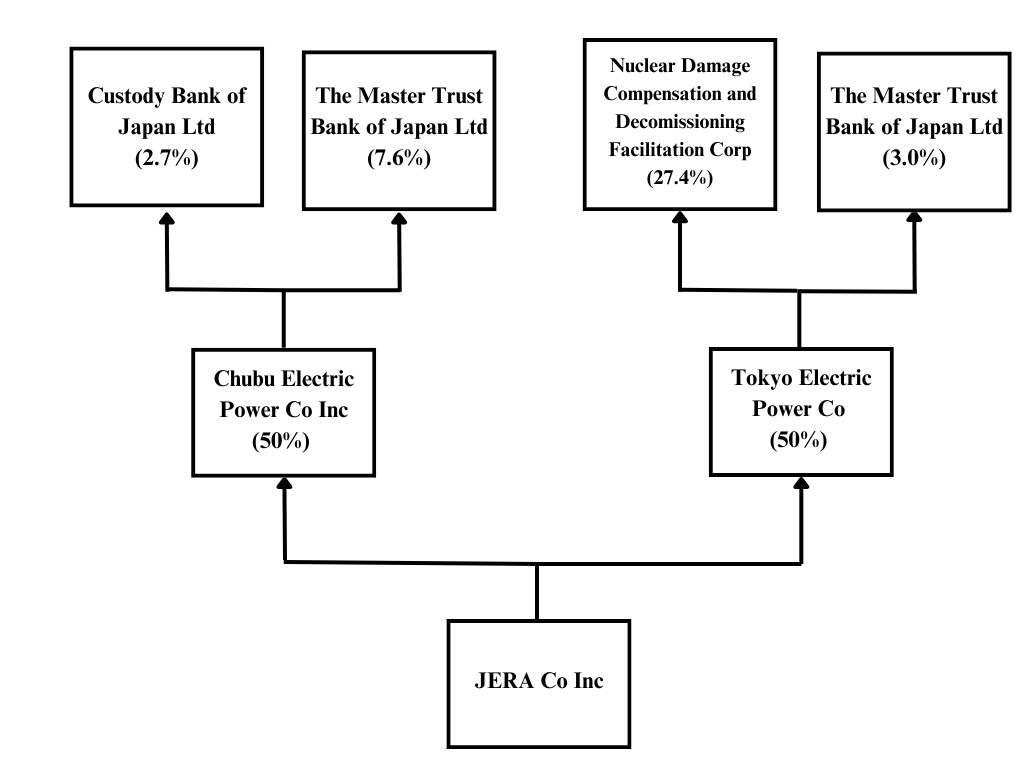
In the example ownership tree shown in Figure 2 for JERA Co Inc, the immediate interested parties are Chubu Electric Power Co Inc and Tokyo Electric Power Co Inc, which each hold 50% of JERA Co Inc. The next level of ownership displays the interested parties of these two entities. The Master Trust Bank of Japan Ltd and Custody Bank of Japan Ltd are the interested parties in the subject Chubu Electric Power Co Inc, and thus have indirect ownership of JERA Co Inc. The same can be said for Nuclear Damage Compensation and Decommissioning Facilitation Corp and The Master Trust Bank of Japan Ltd, which are the interested parties of the subject Tokyo Electric Power Co, and thus have indirect ownership of JERA Co Inc. However, Chubu Electric Power Co Inc and Tokyo Electric Power Co are both publicly listed companies, and therefore, following our definition of parents, each of them is defined as a parent of JERA Co Inc., each owning 50% of JERA Co Inc.
In tracing ownership trees upward from the reported owners, we store data on all entities involved as long as they own at least 5% of a project or a subject entity. We have decided to track ownership of at least 5% to follow the practice of the US Securities and Exchange Commission (SEC), which requires individuals or entities with at least 5% beneficial ownership in a public company to file this through a Schedule 13D form. By storing data on ownership of at least 5%, we provide a nearly comprehensive view of ownership, going beyond the entities that have controlling interests in a project or a subject entity.
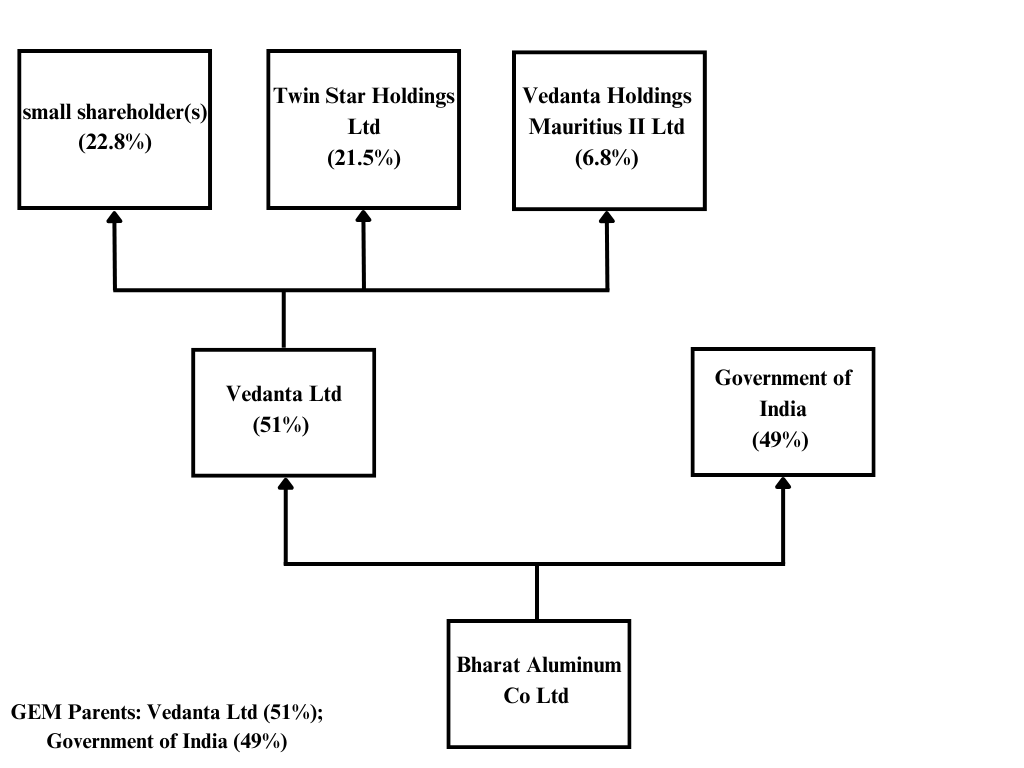
Our parent designations do occasionally list states or state bodies if there weren’t any lower-level entities in a given ownership tree (or tree branch). An example of this is Bharat Aluminium Co Ltd (see the description in Figure 3).
Similarly, if the lowest-level owner in a particular ownership tree is a natural person, then a designation for “natural person(s)” in general is reported, rather than listing names of individual natural persons.
3.4 Mergers and acquisitions
Mergers and acquisitions fall into the three following scenarios:
- Acquisition (change in ownership): the entity’s legal status did not change; its name may or may not have changed, but it is still registered as its own legal entity. It is not dissolved or amalgamated.
In the case of a corporate acquisition, we have labeled the company that is the acquirer as the interested party and the acquired company as the subject (following the BODS terminology for relationships between entities).
- Amalgamation: the entity has been amalgamated into another entity and is therefore no longer active.
When a company has been amalgamated into another, the company’s previous legal identity becomes defunct, and it is no longer active. In this case, we label the companies entity status as “amalgamated” and link its subject companies to the entity that it amalgamated into.
- Merger: the entity has merged with another entity and the entities combined their identities (e.g., ExxonMobil).
In the case of a merger between companies, if one company survives and the other does not, we have mapped the subjects of the acquired company to the acquiring company and labeled the acquired companies entity status as “amalgamated”. We also update the name of the acquiring entity to its new name.
In the ExxonMobil merger, for example, Exxon was technically the acquirer, while the Mobil name was retained as a brand name within the combined company. Therefore, Mobil Corp. was amalgamated into Exxon Corp., and Exxon Corp. became renamed as ExxonMobil Corp.